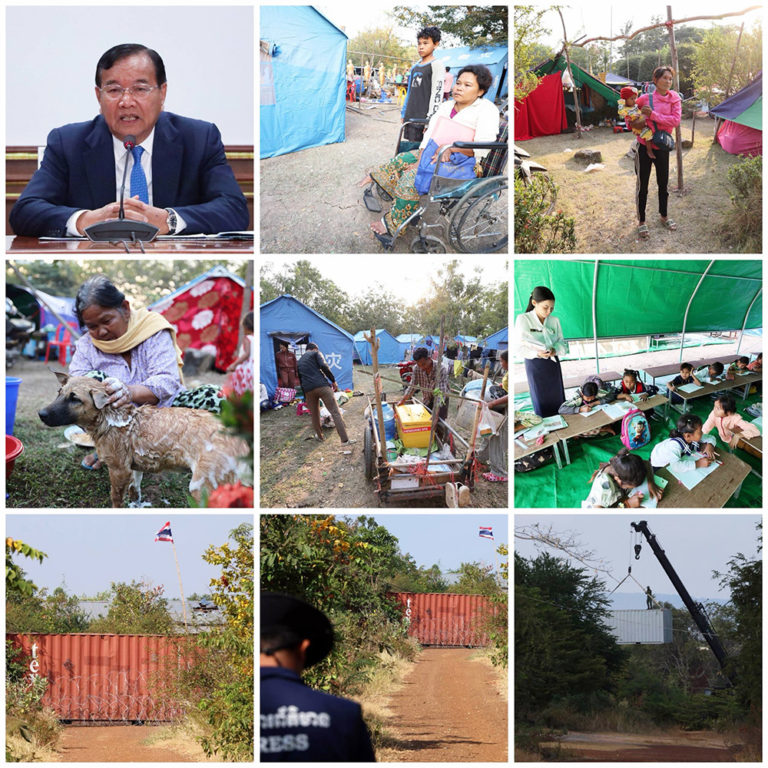
Approximately 4,000 displaced Cambodian families remain unable to return to their homes as Thai troops continue to occupy civilian areas inside Cambodia and block access to villages, Deputy Prime Minister and Minister of Foreign Affairs and International Cooperation H.E. Prak Sokhonn said.
In an exclusive interview with Reuters, H.E. Prak Sokhonn stated that Thai forces are still maintaining their presence in several Cambodian civilian areas and preventing residents from returning to their villages by installing barbed-wire fences and placing shipping containers as barriers – actions he said pose a risk to the ceasefire between the two countries.
“The situation remains calm, but there are still certain risks,” he said, expressing hope that Thailand would fully commit to implementing the ceasefire and cease all hostile actions.
Thai military forces launched large-scale operations against Cambodia from Dec. 7 to Dec. 27, 2025, carrying out premeditated and systematic military attacks along the internationally recognised border. These operations involved incursions, occupation and the establishment of effective control over areas clearly within Cambodian territory.
The affected locations include Prey Chan and Chouk Chey villages and Boeung Trakuon in Banteay Meanchey province; O’Phluk Damrei and the Thmar Da International Border Gate in Pursat province; An Ses, Ta Thav, and Phnom Troap in Preah Vihear province; and O’Smach, Knar Temple, Ta Krabei Temple, Tamone Thom Temple, Chub Angkunh, and Chok Krous in Oddar Meanchey province.
The Royal Government of Cambodia, the Ministry of National Defence and the Secretariat of Border Affairs have repeatedly reaffirmed their firm position that Cambodia does not recognise any alteration of its border resulting from the use of force.
Cambodia remains steadfast in protecting the Cambodia-Thailand international boundary as inherited from the Commission of Delimitation of the Boundary between Indo-China and Siam, in full respect of international law principles, the principle of intangibility of frontiers (Uti Possidetis Juris), the Franco-Siamese conventions and treaties, the maps, and the procès-verbaux of the Commission of the Abornement of the Boundary between Indo-China and Siam, as well as all relevant agreements and documents mutually agreed upon by both parties.