
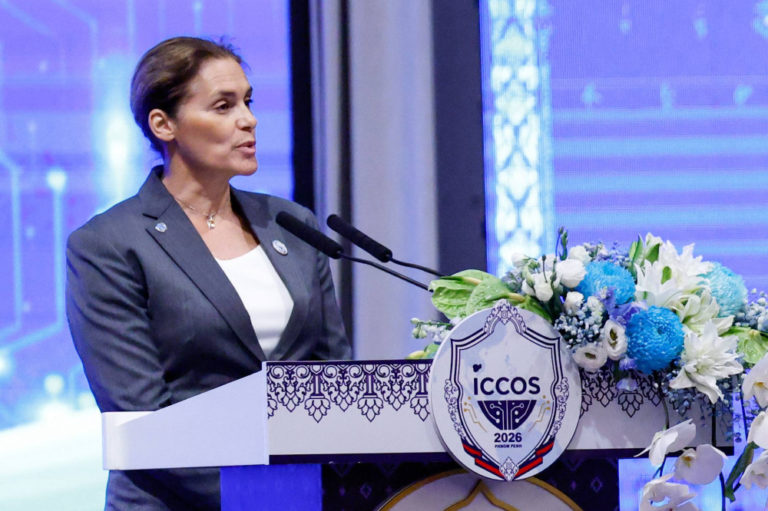
The United Nations Office on Drugs and Crime (UNODC) has called for stronger international cooperation to tackle the rapidly evolving threat of online scams and cyber-enabled crime, stressing that no country can address the problem alone.
Speaking at the opening ceremony of the International Conference on Combating Online Scams in Phnom Penh on Sept. 23, Ms. Delphine Schantz, UNODC Regional Representative, said the conference demonstrated Cambodia’s commitment to international cooperation and reflected a shared priority among countries and partners to develop more effective responses to online scams.
She noted that online scams affect people across all societies, causing financial losses ranging from small amounts in e-commerce fraud to entire life savings in romance scams. The crimes also undermine economic activity and public trust in institutions.
According to UNODC’s latest Transnational Organised Crime Threat Assessment for Southeast Asia, scam-related losses in East Asia, Southeast Asia, Australia and New Zealand are estimated at up to US$114 billion annually, with the figure growing rapidly. The United States has estimated losses of about US$10 billion a year, while Europol has identified fraud schemes as one of the fastest-expanding areas of organised crime.
Ms. Schantz said online fraud has become a major income source for organised criminal groups and increasingly operates across national borders. She described Southeast Asia’s scam industry as undergoing a fundamental shift, with previously fragmented criminal groups becoming part of a sophisticated, transnational and technology-driven criminal economy.
She pointed to rapid technological adoption as a major driver, noting that criminals are increasingly using cryptocurrencies, virtual asset service providers and other technologies to facilitate money laundering and expand their operations. The online environment has also contributed to the expansion of scam centres and other forms of online crime, including illegal gambling and malware distribution.
At the same time, she said the response to online scams is growing, with countries establishing anti-scam centres and taskforces and stepping up law enforcement operations. She cited Cambodia as an example, noting increased operations to shut down scam activities and the creation of the Ad-hoc Commission on Combating Online Scams, while describing the conference as another step towards greater openness and cooperation.
Ms. Schantz identified five areas requiring immediate attention: developing a shared understanding of emerging trends; strengthening regulatory frameworks and digital-evidence capabilities; improving inter-agency cooperation and information analysis; increasing the involvement of the private sector, particularly FinTech and social media companies; and better understanding and disrupting how criminal profits are reinvested to expand criminal networks.
She also stressed the importance of connecting national, regional and global initiatives so that they complement rather than duplicate one another. As criminal networks adapt to law enforcement pressure, she said sustained cooperation is needed to prevent scam activities from simply moving to new locations or taking different forms.
Ms. Schantz reaffirmed UNODC’s commitment to supporting countries and partners in the region and called on participants to use the conference to move beyond discussions and establish clear, actionable measures for more effective responses to online scams at the national, regional and global levels.