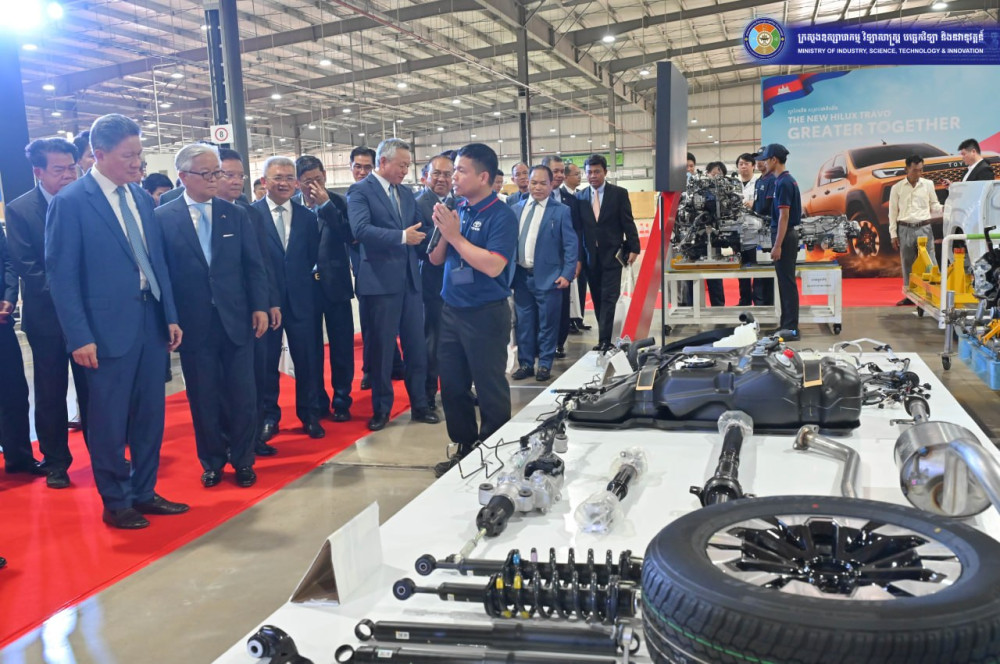
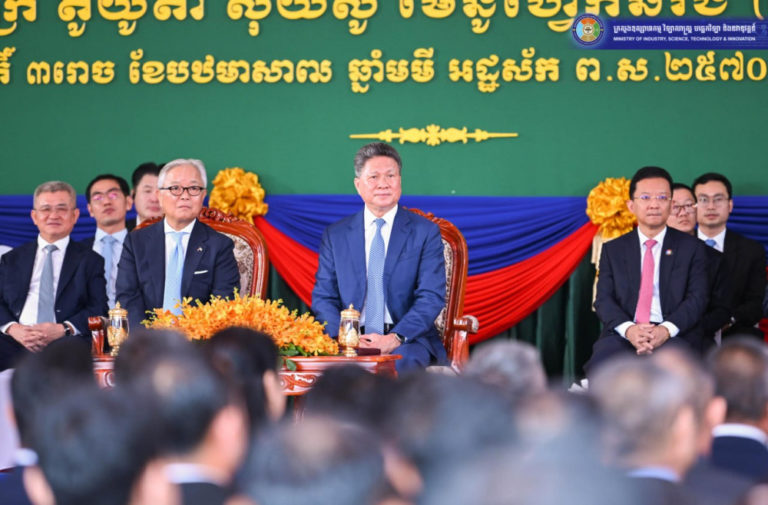
Toyota Tsusho Manufacturing (Cambodia) Co., Ltd. today launched the assembly line of the new Toyota Hilux Travo, the company’s latest investment in Cambodia’s expanding automotive manufacturing sector.
The launch was presided over by H.E. SUN Chanthol, Deputy Prime Minister, First Vice Chairman of the Council for the Development of Cambodia, and High Representative of Samdech Moha Borvor Thipadei HUN Manet, Prime Minister of the Kingdom of Cambodia.
Speaking at the ceremony, H.E. HEM Vanndy, Minister of Industry, Science, Technology & Innovation, said the new assembly line reflects Cambodia’s progress in developing a competitive automotive industry under the Royal Government’s Pentagonal Strategy and the National Policy on the Development of the Automotive Sector 2024-2030.
“The launch of the Toyota Hilux Travo is more than the introduction of a new vehicle model. It demonstrates Toyota’s long-term commitment and confidence in Cambodia’s political stability, investment climate, and industrial development direction,” the Minister said.
Cambodia currently has eight operating vehicle manufacturing and assembly facilities with a combined production capacity of more than 38,000 vehicles per year, with several more factories under development.
Since inaugurating its plant in 2024, Toyota Tsusho Manufacturing (Cambodia) has assembled 6,250 Toyota Fortuner and Hilux vehicles. During the same period, the company expanded its monthly assembly capacity more than tenfold—from 40 vehicles when production began in 2024 to about 400 vehicles per month by the end of 2025.
Minister Vanndy commended Toyota for increasing the use of locally manufactured parts and components to about 20 percent, saying it strengthens Cambodia’s supporting industries and increases domestic value addition.
He encouraged Toyota to further expand procurement from qualified Cambodian suppliers, noting that stronger local supply chains not only create jobs, facilitate technology transfer, and develop skills, but also enhance business resilience amid global supply chain uncertainties.
“Cambodia’s goal is not simply to manufacture vehicles. Our ambition is to build a complete automotive industrial ecosystem where investors, local enterprises, training institutions, and a skilled workforce grow together,” he added.