Prime Minister Samdech Moha Borvor Thipadei Hun Manet has reaffirmed Cambodia’s commitment to eradicating online scam operations, strengthening international cooperation against transnational crime, and pursuing peaceful mechanisms to resolve land and maritime border issues with Thailand.
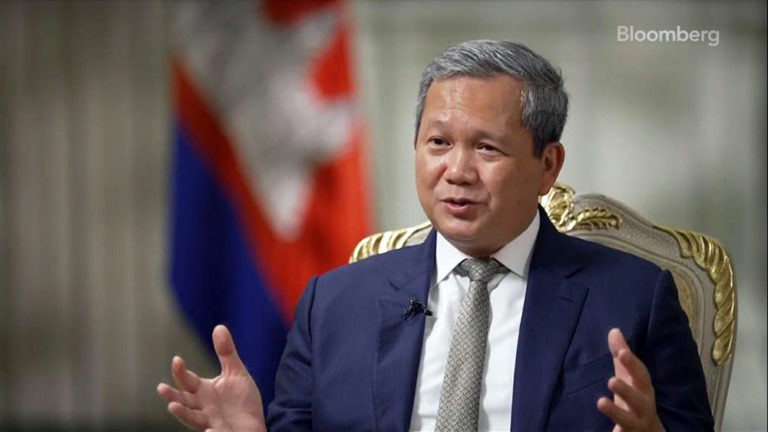
In an interview with Bloomberg, the Prime Minister said Cambodia is determined to make the country an increasingly difficult environment for criminal syndicates to operate, stressing that combating online scams remains a national priority requiring close cooperation with international partners.
“We remain committed to cracking down on online scams, and we have already seen results. Our goal is to make Cambodia a place where online scam operations find it difficult and unprofitable to operate,” he underlined.
Samdech Thipadei noted that Cambodia is working closely with countries around the world, including the United States and China, to combat transnational crime, emphasising that criminal organisations target countries regardless of geopolitical differences.
“These are common challenges that go well beyond geopolitics,” he said. “Criminal networks exploit every opportunity available to them. They can target both the United States and China at the same time through online scam operations or drug trafficking.”
As part of those efforts, Cambodia will host an international conference on combating online scams, bringing together law enforcement agencies and officials from multiple countries, including China and the U.S. Federal Bureau of Investigation (FBI).
Samdech Thipadei Hun Manet said he had invited an FBI delegation to participate in the international conference and that FBI Director Mr. Kash Patel had confirmed that a senior delegation would attend the event.
Responding to concerns that special economic zones (SEZs) could be exploited by criminal organisations, the Prime Minister said the Royal Government has adopted strict preventive measures to ensure that no SEZ is used to facilitate illegal activities.
Samdech Thipadei Hun Manet said he had instructed security agencies, local authorities and agencies responsible for managing SEZs to closely monitor all zones and take decisive action against any operator found violating the law.
“If any SEZ is found to be covering for criminal scam operations, it will be held accountable under the law just like anyone else. So far, we have found no evidence of this in Cambodia, but we are being very careful,” he said.
The Premier added that Cambodian authorities have found no evidence that the country’s SEZs are being used for online scam operations, but stressed that vigilance remains high because SEZs are important engines for attracting foreign direct investment and creating jobs.
Samdech Thipadei also pointed to actions already taken against public officials linked to criminal activities, saying that the Royal Government has dismissed senior military officers, provincial governors and provincial police commissioners after evidence showed involvement in, or failure to act against, scam-related crimes.
“We are continuing our investigations and will continue taking action wherever the evidence leads,” he said.
Turning to Cambodia’s relations with Thailand on border issue, Samdech Thipadei Hun Manet rejected suggestions that Cambodia’s decision to seek compulsory conciliation under the United Nations Convention on the Law of the Sea (UNCLOS) had closed the door to negotiations on land boundary issues.
Samdech Thipadei described such assertions as inaccurate and unfair, explaining that Cambodia sought the UNCLOS mechanism only after Thailand unilaterally terminated the 2001 Memorandum of Understanding (MOU), which had served as the only bilateral framework governing maritime discussions between the two countries.
According to the Prime Minister, successive Cambodian and Thai governments had spent more than 15 years attempting to resolve overlapping maritime claims through the 2001 MOU, including discussions held during the administrations of former Thai Prime Ministers H.E. Srettha Thavisin and H.E. Ms. Paetongtarn Shinawatra.
“Despite Cambodia’s request not to cancel the MOU, Thailand proceeded with its decision,” he said. “We therefore had no choice but to pursue the compulsory conciliation process.”
Samdech Thipadei further stressed that there has never been any agreement or condition stating that initiating UNCLOS proceedings would prevent Cambodia and Thailand from continuing discussions on land boundary matters.
Addressing questions over differences in the two countries’ approaches to the maritime dispute, the Prime Minister said it is too early to discuss expanding the scope of negotiations because the conciliation process is still in its preliminary stage.
Samdech Thipadei noted that both countries have already nominated conciliators and are currently working to appoint the chairperson of the conciliation commission before substantive discussions begin.
“Our focus now is to move the process forward,” he said.
Regarding the U.S. sanctions imposed on Cambodian Senators H.E. Ly Yong Phat and H.E. Kok An, Samdech Thipadei said that is the personal matter for the individuals concerned, and both senators have engaged legal teams to defend themselves and clear their names.