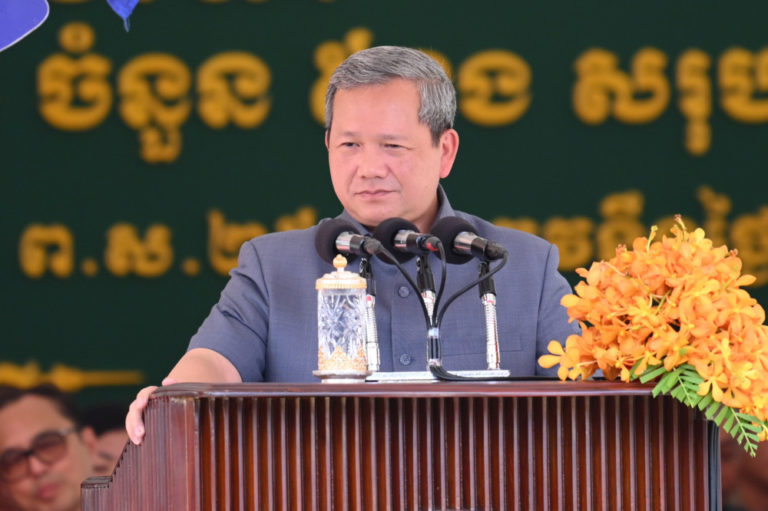
The Royal Government of Cambodia will assume responsibility for funding school nutrition programmes at more than 200 schools when the World Food Programme (WFP) phases out its assistance in the coming years, Prime Minister Samdech Moha Borvor Thipadei Hun Manet has said.
Addressing the inauguration of five new school buildings comprising 55 classrooms in Kampong Thom province on the morning of Nov. 3, the Prime Minister said the school feeding programme in the province was part of the “Partnership between the State and Communities for Education” initiative. Kampong Thom is among the 10 priority provinces selected for the programme.
The programme began in 1999, when the WFP partnered with the Royal Government to provide school meals at 64 schools nationwide. The initiative was designed to support poor communities, recognising that adequate nutrition plays an important role in improving students’ physical health and brain development.
The Prime Minister noted that the programme had expanded significantly, covering 1,114 schools in 2026 and benefiting approximately 300,000 students.
He added that the government had introduced a programme to purchase agricultural products directly from local communities, generating two benefits: providing income to farmers while supplying nutritious food to students.
Samdech Thipadei said the government was not yet in a position to manage school feeding programmes across all more than 7,000 primary schools nationwide, but would continue studying opportunities to expand its responsibilities.
As a first step, the government would gradually take over responsibility for the programme at more than 280 schools currently supported by the WFP, while the State already finances the programme at more than 800 other schools.
He explained that in two years, the WFP would further reduce its assistance to more than 200 schools. The Royal Government would therefore assume responsibility for those schools to ensure that the programme continues to operate and that more than 1,000 students continue receiving meals. Further studies are also underway to determine the next steps.
The Prime Minister stressed that investment in education goes beyond constructing school buildings, providing teacher training, improving teachers’ capacity and supplying educational materials and equipment. It must also include attention to the nutritional needs of primary school students.