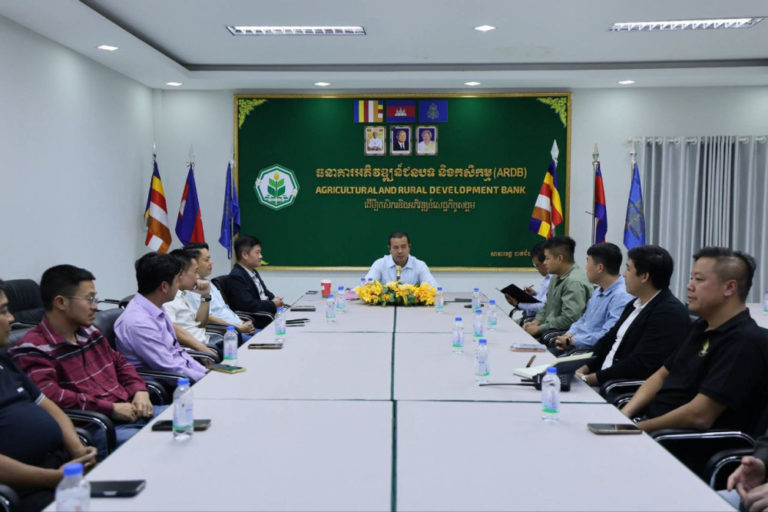
The state-run Agricultural and Rural Development Bank (ARDB) and the Cambodian Rice Federation (CRF) held a crucial meeting on Nov. 27, to assess and to discuss the effectiveness of the Royal Government’s special funds in supporting the rice sector and to develop new strategies.
H.E. Dr. Kao Thach, CEO of ARDB, chaired the meeting at the bank’s Battambang Branch, which was attended by CRF President Mr. Lay Chhun Hour and representatives from major rice mills in key provinces including Pursat, Battambang, Banteay Meanchey, and Kampong Thom.
The primary objective was to thoroughly monitor and evaluate the use of the special funds disbursed through ARDB, which were designed to stabilise rice prices and ensure timely procurement from farmers.
In the meeting, CRF representatives provided key insights into the current downturn, emphasising that the decline in rice prices is not solely due to a large domestic harvest. They stated the primary culprits are global market volatility and intense price competition from neighbouring and international countries.
They also stressed major strategic challenges including warehouse capacity and international market competition, which they concerned that the challenge of Cambodian rice prices, which are difficult to compete with Thai and Vietnamese rice on the international market, is still hot, requiring negotiations and new export strategies.
The difficulty of Cambodian rice prices competing with Thai and Vietnamese rice in the international market remains a significant hurdle, necessitating immediate negotiations and new export strategies, they said.
To address these immediate concerns, H.E. Dr. Kao Thach outlined strategic measures, reaffirming ARDB’s commitment to continue releasing flexible credit packages to ensure mills have the financial ability to collect rice during the upcoming season.
He urged CRF to collaborate with relevant ministries to strengthen export strategies, find better-value markets, and promote the processing of special types of rice to increase added value and competitiveness.
H.E. Dr. Kao Thach also encouraged mills and farmers to move towards signing agricultural contracts and focusing on cultivating rice varieties that are in high demand in the market to mitigate the risk of future price declines.
Cambodia exported about 596,341 tonnes of milled rice in the first nine months of 2025, up 33.7 percent from 445,913 tonnes in the same period last year, according to a CRF’s report.
The country made US$408 million in revenue from the export of the commodity during the January-September period this year, up 21 percent from US$335 million recorded in the same period last year, it added.
Moreover, the Kingdom generated some US$1,209 million in revenue from border-traded paddy rice of some 5.24 million tonnes.