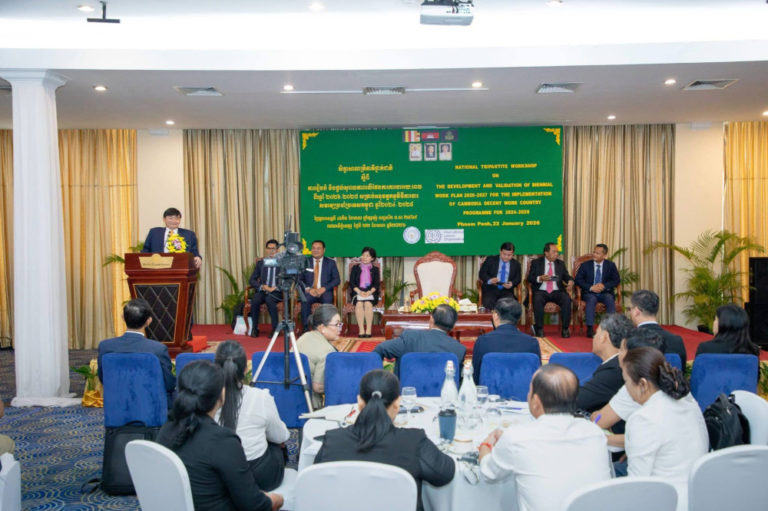
H.E. Heng Sour, Minister of Labour and Vocational Training, presided over the opening ceremony of the “National Tripartite Workshop on the Development and Validation of the Biennial Work Plan 2026-2027” held on Jan. 22, 2026, at the Cambodiana Hotel.
This workshop is part of the ongoing implementation of the Cambodia Decent Work Country Programme (DWCP) 2024-2028, with the participation of approximately 100 representatives from the Royal Government, the International Labour Organisation (ILO), employers’ associations, and trade unions.
The main objective of this workshop is to review and validate the draft work plan for 2026-2027, which focuses on three main priorities: 1) enhancing the strengthening of technical and vocational education and training systems, strengthening and expanding the scope of social protection, and improving labour market interaction; 2) promoting a sustainable, inclusive, digitalised, and more formally registered green economy; and 3) promoting social dialogue, harmonisation of professional relations, and workplace rights in line with national and international labour standards.
Furthermore, this programme aims to strengthen the capacity of tripartite members to manage and monitor the implementation of the DWCP programme to ensure sustainability and ownership at the national level.
Speaking at the event, H.E. Minister highly valued the active cooperation of the ILO and all development partners in supporting the continuous success of the decent work programme in Cambodia.
He recalled that Cambodia is a leading country in the ASEAN region, having implemented the DWCP programme the longest since 2005.
Reaching the sixth phase now is a testament to the Royal Government’s high commitment to improving working conditions in line with the first phase of the Pentagonal Strategy, he said.
The Minister also highlighted the challenges of the annual growth of the new workforce, emphasising that attracting new investments is crucial for creating job opportunities.
He urged the ILO to continue supporting the capacity development of stakeholders and stressed that if employers are well-informed about labour laws and maintain good relations with workers, it will help reduce labour disputes and effectively enhance workplace safety.
At the workshop, Ms. Xiaoyan Qian, Director of the ILO Office for Cambodia, Laos, and Thailand, expressed confidence that this new work plan will set clearer priorities to gradually improve the living standards of Cambodian workers and people.