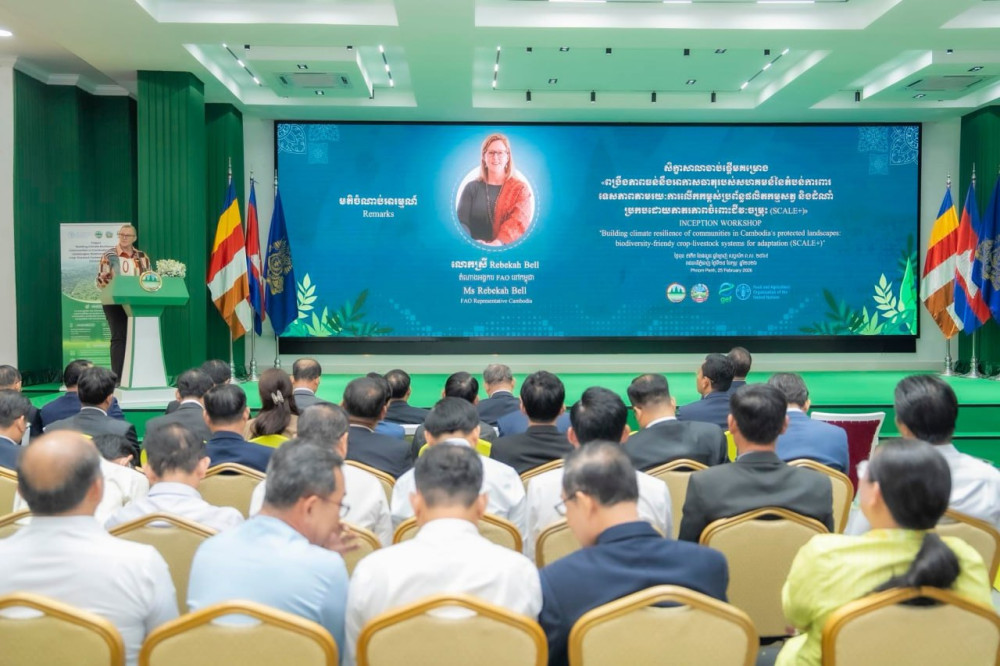
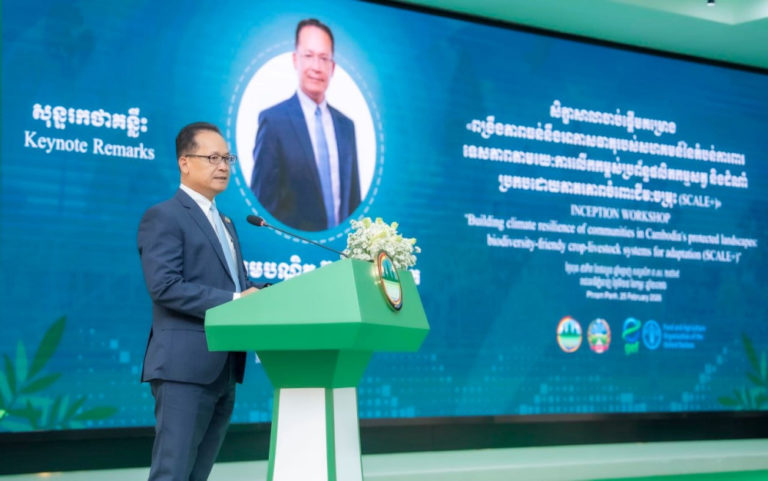
H.E. Dr. Eang Sophalleth, Minister of Environment, officially launched here on Feb. 25 the US$9-million SCALE+ project, “Building Climate Resilience of Communities in Cambodia’s Protected Landscapes through Biodiversity-Friendly Crop–Livestock Systems.”
The project is implemented by the Ministry of Environment in collaboration with the Ministry of Agriculture, Forestry and Fisheries (MAFF), with technical support from the Food and Agriculture Organisation of the United Nations (FAO) and financial support from the Global Environment Facility (GEF).
The initiative aims to strengthen the climate resilience of communities, ecosystems, and livelihoods across Cambodia’s protected landscapes while promoting biodiversity conservation and sustainable natural resource management.
Ms. Rebekah Bell, FAO Representative in Cambodia, reaffirmed FAO’s commitment to supporting climate-resilient livelihoods and biodiversity conservation.
Cambodia remains highly vulnerable to climate change, with increasing pressures affecting agriculture, forests, and rural livelihoods. These challenges threaten development gains and disproportionately affect rural communities that depend on natural resources for their survival and income.
The project targets protected landscapes, including Boeung Per Wildlife Sanctuary, encompassing 28 Community Protected Areas, and Prey Lang Wildlife Sanctuary, which includes 9 Community Protected Areas.
These landscapes play a vital role in sustaining livelihoods, conserving biodiversity, and maintaining essential ecosystem services.
They support hundreds of thousands of people who depend on forests, agriculture, and natural resources for their livelihoods. However, growing pressure from climate change and unsustainable land management practices threatens these ecosystems, underscoring the urgent need to strengthen livelihoods while safeguarding biodiversity.
SCALE+ promotes integrated solutions to strengthen climate resilience and protect ecosystems.
The project supports adaptation planning, biodiversity-friendly production systems, inclusive livelihoods, and knowledge sharing to scale up climate action.
It will benefit over 84,000 people, at least 50 percent women, while restoring 92,000 hectares of community-protected areas and rehabilitating 2,000 hectares of degraded land, strengthening sustainable land management, and building resilient livelihoods.
The workshop brought together government agencies, development partners, civil society organisations, and community representatives to review the project framework, strengthen coordination, and identify opportunities for collaboration and co-financing. Participants discussed implementation priorities, risks, and practical solutions to ensure effective delivery and long-term sustainability.
Strengthening sustainable production systems and inclusive value chains, SCALE+ will enhance resilience for communities living in and around protected landscapes while safeguarding biodiversity and ecosystem services.