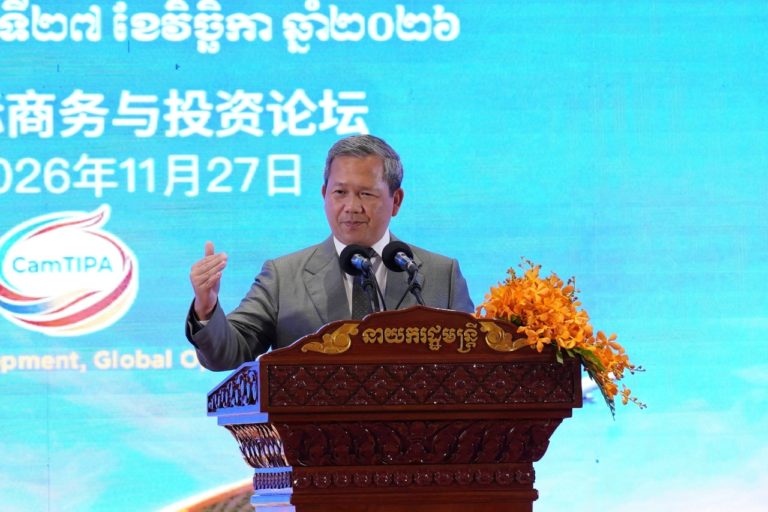
Cambodia has decided to graduate from the Least Developed Country (LDC) category in 2029, rather than 2027, despite having already met all three graduation criteria, to ensure that the country is fully prepared to compete in the new economic environment and sustain its development gains, Prime Minister Samdech Moha Borvor Thipadei Hun Manet said on Friday.
Speaking at the opening ceremony of the Cambodia International Business and Investment Forum at the Koh Pich Convention and Exhibition Centre in Phnom Penh, Samdech Thipadei explained that Cambodia had met the requirements for LDC graduation in 2021 and was expected to proceed with the graduation process this year. However, the Royal Government decided to defer the transition until 2029.
“Based on the country’s performance, Cambodia could proceed with graduation in 2027. However, following a comprehensive assessment, the Royal Government decided to defer the transition until 2029 to ensure a successful and sustainable graduation,” he underlined.
“We can benefit from certain preferential treatments as a Least Developed Country, but we cannot remain in this status forever. We must also strengthen ourselves, and we want to graduate when we are fully prepared,” Samdech Thipadei said.
According to the Prime Minister, the decision to graduate in 2029 was driven by the need to strengthen the country’s competitiveness and prepare it adequately for the opportunities and challenges associated with entering a new economic environment.
“When we graduate, we will enter a new environment where we must compete, and we need to be fully prepared for that,” he stressed.
The Premier acknowledged that Cambodia currently benefits from certain preferential arrangements under the LDC framework while also facing various challenges. Following graduation, the country will encounter a different set of challenges and opportunities, requiring greater efforts to strengthen its economic competitiveness.
At the same time, Samdech Thipadei noted that graduation would create new opportunities for Cambodia, particularly by attracting more domestic and foreign investment and expanding access to larger and broader international markets.
Cambodia has already fulfilled all three internationally established criteria for LDC graduation.
The first criterion is Gross National Income (GNI) per capita, which requires a minimum threshold of US$1,222 in 2026. Cambodia’s GNI per capita has reached US$2,750, significantly exceeding the required level.
The second criterion is the Human Assets Index (HAI), which has a required threshold of 66 points. Cambodia has achieved a score of 77.50, reflecting progress in its human development indicators.
The third criterion is the Economic and Environmental Vulnerability Index (EVI), which requires a score below 32 points. Cambodia has recorded 22.15 points, well below the threshold.
With all three indicators meeting the required standards, Cambodia is eligible to graduate in either 2027 or 2029. Nevertheless, the Royal Government has opted for 2029 to allow more time to strengthen national capacities, improve competitiveness and ensure that the country’s development gains are sustained after graduation, the Prime Minister said.
Samdech Thipadei emphasised that Cambodia’s objective is not simply to leave the LDC category, but to ensure a successful transition, with sufficient preparation to withstand new challenges and seize emerging opportunities in the global economy.
Globally, LDCs represent the poorest and most vulnerable segment of the international community. They comprise more than 880 million people, or approximately 12 percent of the world’s population, but account for less than 2 percent of global GDP and around 1 percent of global trade in goods.